This is the blog of fine art photographer and artist Fred Braakman. I hope you enjoy my postings and discussions about art and photography.
Total Pageviews
Tuesday, 31 May 2011
Solitary Photography
A friend of mine told me that he feels most photographers are solitary people, who like to carry out their craft alone. I think there may be some truth to that in certain cases, and I do like to go out at times by myself and do my photography by myself. But there are times I really like to go with a group of like minded photographers. We may each have our own vision of a scene in mind, and that is good. We don't want our photographs to look like someone else's photographs, and that actually rarely happens. Its amazing how 10 people all taking the same shot will get their own representation of an image, different from the rest. Once or twice a year I go with several other photographers on day trips or even for a week at a time. We can learn from one another, not just the technical stuff, but the artistic side of photography, which is my favorite topic of discussion. Too many focus on the technical issues associated with photography, rather than the artistic side of it. One can focus all he wants on the type of camera, how many pixels, what speed of film, etc., but all that does not result in good art. I believe that a person can make a good work of art whether its a painting or a photograph. Becoming a good photographer takes a long time, just like it takes a painter a long time to develop his or her craft. It isn't the camera that makes good photography, just like it isn't the brush that a painter uses that makes him or her a good painter. Getting back to the solitary side of photography, I do feel that this solitary side of an artist does contribute more to development as an artist, because what we portray in the image is a statement of who we are, which can only come from within.
Monday, 30 May 2011
What the Camera Sees
When we take a photograph with a digital camera (as in this case), does the camera reproduce what we see, or what is actually in the scene? One element of photography that is always of concern is the dynamic range of the camera, and the scene we are photographing. The eye can see an equivalent of about 24 "stops", while the camera can see only 14 to 16 "stops". So the camera does not reproduce the actual scene as it is, in most cases. If the scene does have a very narrow dynamic range then the camera does come closer to doing that. Because the eye is so much more capable of seeing such a wide dynamic range, we can become disappointed when we see the final outcome of a photograph that we have taken. I used to believe that I needed to have a "better camera" because my pictures were so awful. Not only did I not understand the aspect of dynamic range, I also did not know how to actually expose a picture properly, and I always chose the "auto" mode, believing that the camera would know how to expose the shot properly. In some cases a good exposure can result, especially with today's modern cameras, but in situations of high contrast, it is very unlikely that the camera will know how to expose the scene properly. Dynamic range and proper exposure are just a few aspects of this topic.
Friday, 27 May 2011
Twisted Root
This image just fell into my lap. It had almost perfect composition. The central focus, of course is the twisted root, and it is nicely balanced by the green shrub just below it, to the left. The root forms a diagonal line from the top left corner, across the center of the image. There is also a balancing element at the lower right hand corner which is the lower edge of the red sandstone, and the grassy shrub to the right keeps the eye focussed in the middle of the scene. The eye shifts between the green shrub on the lower left and the grassy shrub to the right. The red - green color opposites create a nice color vibration. I find that I am creating less color saturated images than I used to. I toned down the reddish and yellowish colors somewhat. This was shot with my Nikon D700, and the original scene was quite well reproduced.
Tuesday, 24 May 2011
Needles District: Canyonlands Red-Green Color Contrasts
This was taken during late afternoon when the sun was still high in the sky. Its a good example of shooting in the shade to obtain the optimum color saturation. I'm always amazed how much color is available under these conditions. Had I taken the shot in bright sunlight, the colors would have been washed out. The sun was also behind the large rock to the right, and this can result in a halo effect on the edge of the rock. It takes a little tweaking to eliminate that halo. I love the color contrast, with the greens playing against the warm reds. Its a classic example of opposite colors on the color wheel. The green - red opposites on the secondary color wheel, vibrate against one another. Another example would be orange and blue. I look for these contrasts in nature, and they help to define the image as much as lines and space.
Sunday, 22 May 2011
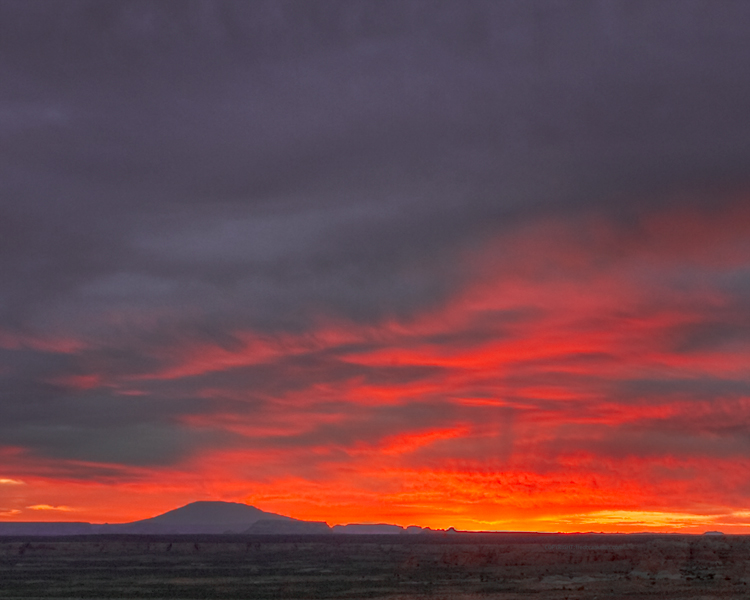
Another Sunrise Navajo Mountain
Navajo Mountain is in the distance as the sun rises at about 6 am. The weather had improved, so we did not have to suffer from the freezing temperatures this day. Motivation to get up at 5 am to go and shoot a sunrise when the weather is bad usually is lacking. This was the case on our first sunrise shoot at Horseshoe Bend a few days earlier. As we drove up to the trail to hike down, it was snowing, and the wind was blowing. No sane person would think of going on a hike in these kind of conditions. But bad weather can result in some beautiful photographs. The light may be fleeting, but all it takes is 5 minutes of sunlight to get a good shot. Usually that means that the rest of the morning may be a fruitless wait for better conditions, but at least you have a few good shots.
Wednesday, 18 May 2011
Balancing Act
I am always amazed by the natural features that can be found in a place like Arizona. How long will these formations last? The fact is that there is constant erosion taking place in these areas, with the result that the land and topography will eventually be altered, sometimes quite rapidly. Here the erosion taking place is mostly due to the wind, and sand being blown by the wind upon these land features. Flash floods can also be a factor, but in this location I think that the wind is the major influence. These hoodoos are situated on a high mesa like feature, and I remember that it was quite windy here at the time when we were shooting, not to mention very cold. It was difficult to get a decent shot here, since there were at least twenty people with cameras and tripods present. Sometimes other photographers get in your shot, as was the case here. Actually, one was in the left hand corner of the frame, but all I had to do was crop the shot, which I normally do anyhow, from the standard 35 mm frame to a 4x5 format frame, which I really like.
Sunday, 15 May 2011
Sunrise Overlooking Page: Navajo Mountain
In the far background, to the north east of Page is Navajo mountain. Navajo mountain is sacred to the Navajo peoples. It is the predominant landmark in the region, and is located just north of the Arizona border. The mountain "represents the head of the sacred female and pollen figure of Navajoland, of which Black Mountain is the body, and Balukai Mesa the lower extremities." At one time "the Navajo were afraid to go above the lower elevations of the mountain, and had great fear of the underground rumblings that used to be reported on the western slopes. In ceremonial parlance the whole system (of geographical features) is called Tádídiíín Dzil (pollen Mountain)."
Subscribe to:
Posts (Atom)